Welcome to this guide about seed libraries. To be a seed librarian, the only requirement is that we stay in a humble mindset and keep learning our whole lives, whenever we can. This section aims to help us plan our seed garden, to educate ourselves, and to teach others.
Section A and B, that together make up the Educating section, are the only parts published so far. Keep an eye out for other sections of the guide in the future!
A) Planning Our Seed Garden For Transformative Education
A seed garden is a living seed library. Not only that, it serves as habitat for all kinds of animals! This space is also a classroom for you and your family, and if it is in public, it can do so for the whole community. Let’s dive into creating one!
What Plants Can Teach Us
“When I don’t know what to do, I go to the plants. To learn from the land, you need to be in the presence of a teacher.”
Robin Wall Kimmerer
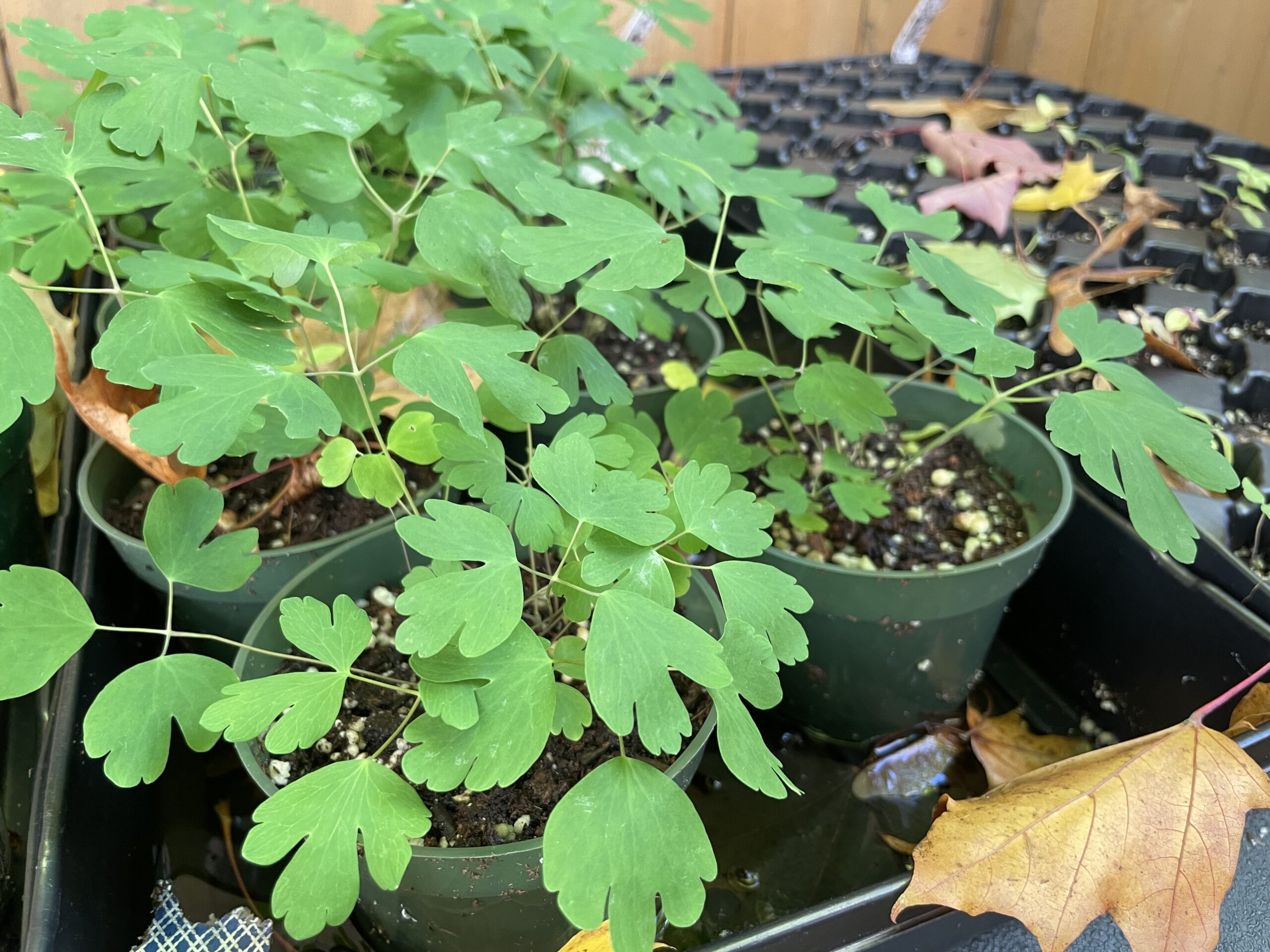
Education isn’t top-down. It can often grow from the ground up. Quite literally, in the case of our plant relatives. When it comes to stewarding a piece of land, our photosynthetic friends can definitely teach us a few of their tricks.
That’s why us, Wildflower Seed Librarians, can learn not only from our human counterparts, but also from the plants that surround us. The Transformative Education part of this guide will talk about ways to stay informed about plants. This section spans the whole year, because learning, as well as educating ourselves and others, never stops.
Read blog about Transformative Education:
How Wildflower Seed Libraries are a Model for Transformative Education
Asking questions to further our understanding
I will first ask you some example questions as an exercise to start your Wildflower Seed Garden.
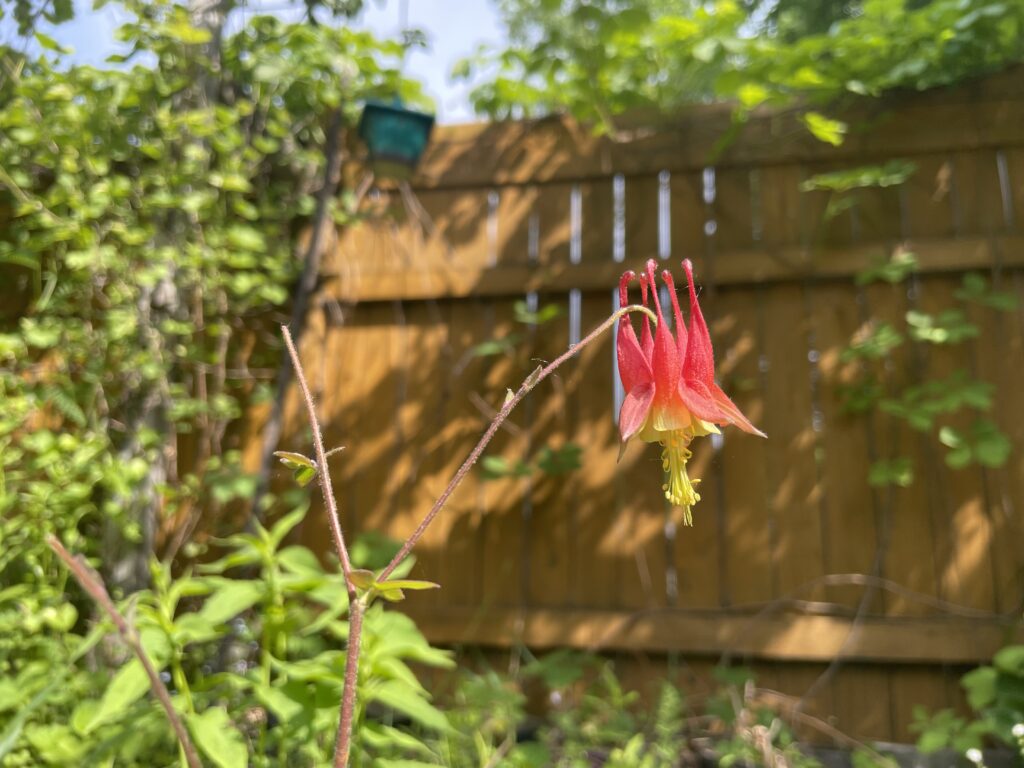
For me, gardening is where it all starts. It’s where I started my educational journey towards becoming a seed librarian, but also where I learned more about the denizens of the garden — the plants and the animals, among other beings, who call it home.
I recommend just diving in and starting from seed. It can be a balcony with containers as much as a big field. And if you absolutely don’t have a space, there are options:
- Your local community or collective garden
- Your friendly neighbor / friend / family member
- The Butterflyway Project can enable public garden creation!
- As a Seed Librarian, find a “co-librarian” to plant things in and help maintain the seed source!
For Land Stewards : Questions for Planning our Space
1 – Who do I want to see in this space?
Identify what you already have growing, and make a list of living things you want to see. Do you want more birds in your spaces? More buzzing insects? These decisions are important because they will inform how you act, which species you choose and where you put your energy. It’s okay to focus on our yard before our community involvement, since it’s where we can go often and easily!
Results
- Our plant and landscaping choices are enriched (host plants can attract certain butterflies, and landscaping features like ponds can attract many birds and amphibians)
- We learn about nature in an accessible way through creating an ecosystem!
- We get seeds for our Seed Library
The whole point of a Wildflower Seed Library is to promote native plants, because these are essential to the lifecycles of many insects, who then serve as bird, amphibian and mammal food. Doug Tallamy and Jarrod Fowler have compiled a list of keystone plants by ecoregion, which help native pollen-specialist bees and butterflies the most!
Resources:
Xerces – Pollinator plants
Vascan – native plants for your region
iNaturalist; GoBotany – identification
2 – What plant choices do I want to make?
Think of your presence in the community.
Do you want a sanctuary where the pollinators and birds can spend their summers? Do you want to focus your attention in the front yard, where you can show intent and dedication? Or in the backyard, where it’s more quiet and there are generally less eyes on your – perhaps unconventional – gardening methods? Or is it a public area, where there are going to be even more eyes looking at it?
Opting for a maintained look can be a wise decision, but can involve more effort to do properly, but an ocean of mulch can drown out lots of native plant species.
For the statement you are making, this can be important for some neighbours. Depending on the neighbourhood, a sign can go a long way to demonstrate that you’re doing this for the pollinators. Do your neighbours spray their yard? Do they mind an unconventional look? These are all questions we should ask ourselves and consider when thinking of landscaping for wildlife.
And most importantly, which species do you want to carry in your library?
These decisions are up to you, of course, but gardens are part of the landscape.
Results
- We get the right plant species, and the right landscaping methods at the right place!
- We can rally more people to our cause!
- We get seeds for our seed library.
Resources:
Ottawa Wildflower Seed Library
Plant Finder – Native Plant Trust
Seed Sitters – David Suzuki Foundation
3 – At what frequency do I plan to add new things, or amend the space?
It’s normal to feel the urge to create your entire vision all at once — to dive in with wheelbarrows of compost and trays of plugs bought all at the same time. But remember: nature works in cycles. Our seed library gardens benefit from this same patient, seasonal approach.
Just like any good relationship, the one we build with our garden space takes time. Observing and responding to what works (and what doesn’t) is an ongoing process. Lots of seeds need stratification over winter. Some perennials might not flower until their second or even third year. And some lessons you can only learn by being present — watching which plants thrive, which ones struggle, and how the space responds to changes in sunlight, moisture, and human interaction.
Rather than thinking of your seed library garden as a one-time project, think of it as a living calendar. A story unfolding chapter by chapter.
Optional : Observing through journaling
You can definitely try to document, with every new plant added, who comes to visit. You can use a notebook, a digital doc, or even a seasonal photo journal. The important part isn’t the format — it’s building a relationship over time with your garden.
“Nature Journaling will enrich your experiences and develop observation, curiosity, gratitude, reverence, memory, and the skills of a naturalist. It helps you discover, think, remember, and integrate new information with your existing knowledge. Train your mind, and the world will offer you its secrets of wonder and beauty.”
John Muir Laws
Resources:
Wild Wonder – Nature Journaling Resources
John Muir Laws – Nature Journaling: Get started and grow!
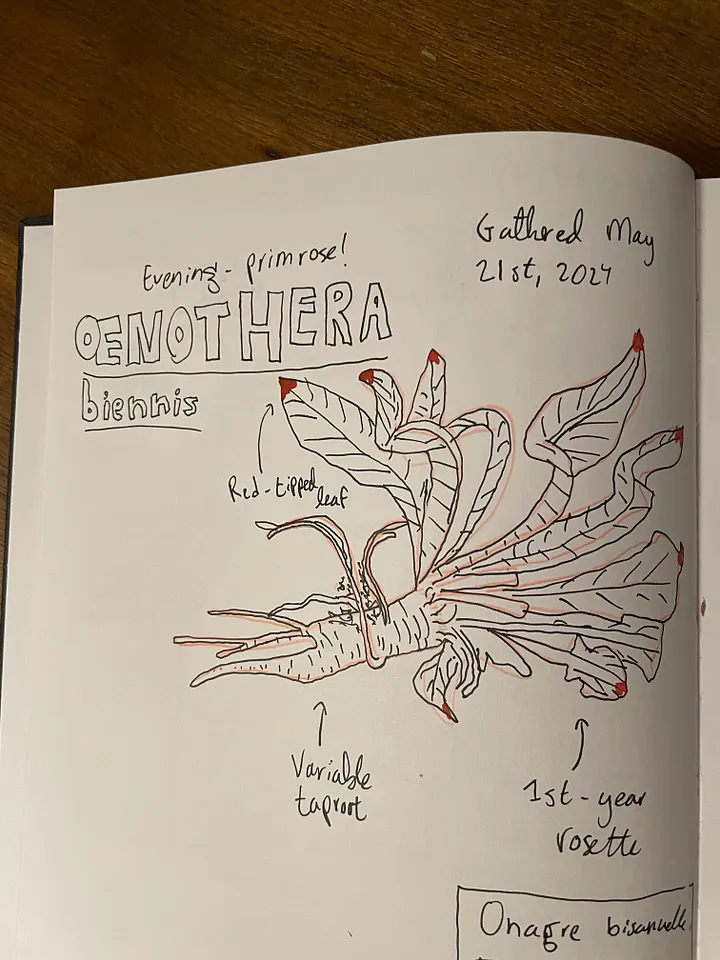
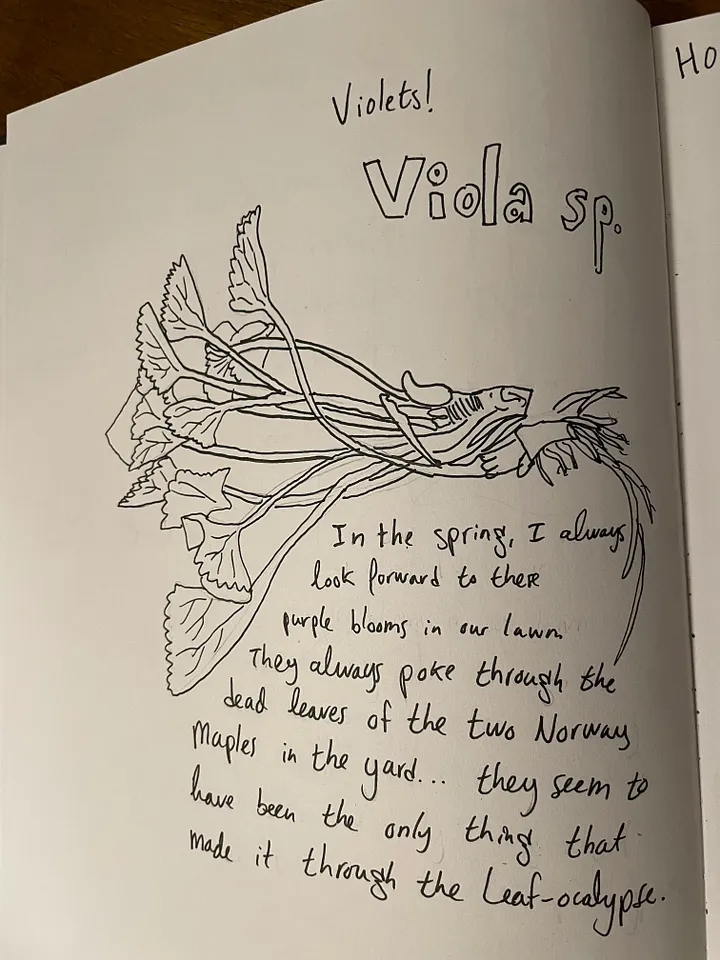
Two journal pages of some ubiquitous native lawn denizens : Common evening-primrose (Oenothera biennis) and violets (Viola sp.)
Journaling Prompts
Here are some optional prompts to start deeper inquiry:
Beginning the Journey
- What’s drawing me to this work right now?
- What is one small, meaningful change I want to make this season?
- What’s one thing I don’t know yet — and how might I learn it through observation?
Tracking the Seasons
- What is happening in the space this week/month? (Think weather, wildlife, new growth, unexpected changes.)
- Which plants seem happy here? Which ones are struggling?
- What signs tell me it’s time to plant, harvest, rest, or add something new?
Observing Relationships
- What insects or animals have I noticed visiting this space?
- How does this space change when I leave it alone for a while?
- Who else — human or non-human — is using this space?
Amending & Evolving
- What is one thing I tried that didn’t go as expected — and what did I learn from it?
- How often do I realistically want to be planting or changing things?
- What would it look like to let the plants lead, instead of my plans?
Looking Ahead
- What does success look like for me, one year from now?
- What am I most excited to witness in this space as time passes?
- What kind of legacy do I hope this garden will leave — for pollinators, people, and the land?
I hope these serve as examples of what you can do to let the plants teach you more about your space. The rest will come together!
Transformative education, and seed libraries, do not stop there. It is instrumental to our practice as seed librarians to keep learning and to stay humble. That’s the way of good science, and the way of a good seed library network!
B) Pooling Community Resources
Once we have learned from our garden, or from others if we don’t have a garden, another way to start a Seed Library is to pool community resources together, to then share them out.
The goal of this section is to educate people in the community about good practices, to have them grow out their seed gardens too and trade seeds with each other through a Wildflower Seed Library. This is also a good place to start doing the first steps if you do not have the capacity to do a seed garden.
Channels
Web presence can be essential for a large-scale library, as it is what gathers people. Unless we live in a very tight-knit community, we need a way to get the information across. This all depends on where we live, of course, and how much we want the library to spread.
Some of the best ways to get the information across, from digital to analog :
- Facebook group (Ottawa WSL’s group is what made the group have the most traction in the past)
- Community newsletter (A plain email, a newsletter service, or a platform like Substack)
- Example : Bloom and Buzz
- Public social media presence
- Examples as of 2025
- Meta (Instagram and Facebook) : still the most-visited platforms to this day
- Bluesky (Can be popular among some circles, might gain more traction in the future but still limited locally)
- Examples as of 2025
- A YouTube Channel
- Mailouts or door-to-door (experimental)
- Regular (or not) community events to educate and make things happen
- Print materials which can be sent in letters or events
- Flyers of different formats
- Zines (Self-published booklets printed at home and folded by hand)
- Information cards
But no matter what the format is, we need to think about what goes in it.
The key messages
Ottawa Wildflower Seed Library has kindly shared a list of generalized key messages on native plants, for which each one of us seed librarians can use as a springboard for our messages.
These are some of the 2023 key messages, the focus of the seed library’s messaging. Use them as standalone “talking points” or as ideas for promoting your seed exchange operation.
–
- Why native plants
- Human side:
- Choose the right plants for the right conditions
- no need for fertilizers, pesticides, nor watering after they are established
- They grow without human intervention
- Ecological side:
- Plants and wildlife have been co-evolving for thousands of years
- Imported and human-modified plants have been introduced faster than they adapt
- Pollinators are the adult form of butterflies, and insects
- More than 90 percent of moth and butterfly caterpillars eat only particular native plants or groups of plants when they are babies
- Growing native plants provides food for their babies and their whole life cycle
- Human side:
- Time to plant is December and January
- Native seeds evolved to sustain our harsh winters
- Need freeze thaw cycle to break their protective shells to germinate
- No gardening experience required, we will help you at our events
- Very simple, take regular pots or juice jugs, use potting mix,put seeds on top, and put them outside for the winter.
- Will not have success if you just throw them on the ground, part of the ecosystem, will get eaten or blown in the wind
- Just need to keep them moistened until you move them to your garden
- Do not need a big garden, a balcony will do
- Have a selection of plants that grow well in containers
- Get free seeds at our # upcoming events across the city, between now and Dec 27
- Visit our website to find the one closest to you at WEBSITE URL
- Join our Facebook group or Instagram to learn more about native plant gardening and our ecological impact
- YouTube channel where we provide a lot of resources to harvest and sow native seeds
Stay updated, as this section (and the rest of the Guide) will grow and evolve.